


The Sobriety Wasn't the Breakthrough. This Was.

For most of my 20s and 30s, I thought my life was the problem.
I thought if I could just find the right relationship, the right job, the right amount of control, the ache underneath everything would finally quiet down.
It didn't.
I remember getting to the bottom of a wine bottle and realizing, almost outside of myself, that I'd finished the whole thing without noticing. I remember holding myself back from risks, not because I lacked ambition, but because some part of me was terrified of finding out I wasn't enough. I remember looking at other people's lives and thinking they'd been handed something I hadn't.
What I didn't understand yet was that I wasn't running from my life. I was running from myself.
Here's the part most people don't talk about: quitting the escape hatch is not the healing, it's the doorway to it.
When I finally put down the cigarettes and the wine, I was so proud of myself. I had stopped getting hangovers a while back, but my head was clearer in the morning. What I had hoped for was a new lease on life not being chained to escapism, but what I got instead was anxiety I didn't know how to hold.
For years, those things hadn't just been "bad habits." They were the pressure release valve for feelings I never let myself fully feel: grief, fear, betrayal, the quiet devastation of feeling unseen.
Without the numbing, all of it surfaced at once.
That's when I had a choice most people don't realize they're making: I could interpret the anxiety as proof that something was wrong with me, or I could get curious about what it was trying to show me.
I chose curiosity, barely. Some days I chose it by accident.
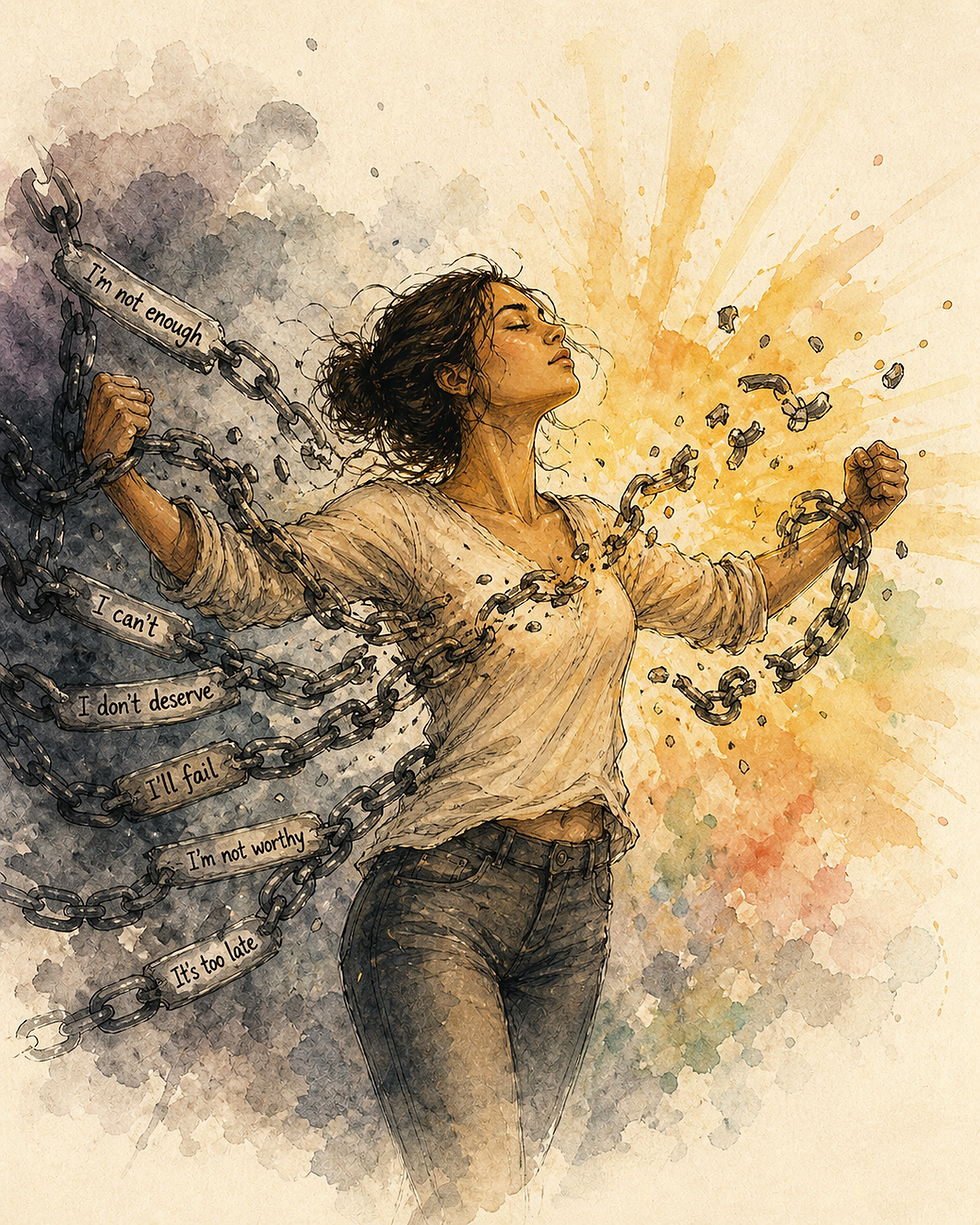
What I found underneath the anxiety wasn't weakness but a set of beliefs I'd been operating from without ever questioning them: I'm not safe unless I'm in control. If something good happens, it'll be taken away. Other people get to be happy, but I get to just survive.
Those beliefs weren't randomly assigned. They were built from every moment I felt hurt, dismissed, or betrayed and never had the tools to process it. So I adapted the only way a nervous system knows how: contract, numb, control, repeat.
The turning point wasn't a single moment of clarity. It was a decision to stop doing this alone. I joined a group coaching program, not because I thought it would be life-changing, but because I was curious. Something happened in that container that willpower alone never gave me: witness and reflection.
People who could see the pattern I couldn't see in myself.
That's when the real shift happened. Not "I stopped drinking." But: I stopped abandoning myself the way life had once abandoned me.
From there, everything reorganized. And let me tell you, it was not perfectly or instant, but it was honest.
If you're in a deeper phase of your own healing, past the "just stop the bad habit" stage, into the layer where you're facing the beliefs underneath the behavior, I want you to hear this clearly: The anxiety that shows up when you stop numbing isn't a setback. It's information. It's your system finally trusting you enough to show you what it's been protecting you from.
You don't need to white-knuckle your way through this part. You need support that can meet you at the depth you're actually working at.
That's the work I do now, not surface-level motivation, but the real excavation. Because I've been at the bottom of that wine bottle, and I've also been on the other side of it. I know the terrain, and I know the way through.
If this resonated, I'd love to hear where you are in your own process. If you're ready for support that goes beneath the behavior to the belief, I offer a few different ways to work together from 1:1 sessions to deeper group containers, depending on what kind of support you're craving right now. Some women need a private space to go deep. Others need a community of women doing this work alongside them. Both are sacred. Both work.
Whatever that looks like for you, I'd love to help you find it. Send me a message and let's talk about what kind of support fits where you are.



Comments